A relaxing dinner at home can really bring out the eater in me. And when it is a dinner filled with surprises, that's even better.
It was what I thought a casual hot pot dinner at a family friend's place. These are people who know their food and would go the mile to get the best and freshest ingredients dinner. I have already up my expectations and was expecting a flavourful soup base with a table full of tender and thin slices of meats, fresh seafood and vibrant green veggies.
We were greeted with a bottle of Château Haut-Bages-Avérous Pauillac 2001, a Cabernet Sauvignon from Bordeaux that has the scent of spicy fruits. A medium bodied wine that needs only 15 minutes out of the bottle, it is quite tannic and you can taste blackberries and cedar. I don't know much about wines, but it was very well balanced and I couldn't stop drinking it.
A very strong yet pleasant aroma started to drift out from the kitchen. It wasn't a familiar scent but I know it was from something savory and my mouth started to water. I couldn't figure out what it was but finally, the dish was brought out and I saw medium sized golden brown nuggets on a plate.
Showing posts with label Chinese. Show all posts
Tuesday, March 1, 2011
Wednesday, February 23, 2011
A Pleasant Surprise
You hear quite a few wine pairings with Chinese/Asian cuisine these days. And just a few days ago, I received an email from Lifestyle Asia saying that they will be having a new biweekly column on Asian food pairing with new world wines called "The Flavours of Asia". Tastings and pairings will be done by local experts with the finest palates invited by Moët Hennessy Asia Pacific.
I've actually done a few at KEE where we hosted dim sum lunch and paired with various different wines, with wine makers explaining why it works and with the chefs commenting on how he got his inspirations on matching spring rolls with a glass of light pinot gris.
Anyways, before I get too far off topic, this post is about an awesome discovery for me, one of the few posts about chinese food & wine pairing. Apparently, the Chinese Thousand Year Old Egg (皮蛋 / Pidan) with pickled ginger pair rather well with red wines (and sweet whites too). This is of course not a new discovery/delicacy as Yung Kee (famous for their thousand year old eggs as well as roast goose) has been serving their guests this combo for awhile.
But is an 'omgosh' moment for me. Reaction was "@*$#&(#_)*^&%@&$)@!".
Red wine & pidan wor. Dim duk ga. cannot la! But if Yung Kee is serving this proudly, there's gotta be some truth behind this.
I finally had a chance to try it tonight and it was indeed a very pleasant surprise. Why I think the flavours work together is because of science. Through preserving, the thousand year old egg has a higher alkaline level (higher pH balance makes this a 'base'). And that's why when you eat it with the pickled ginger, which has a low pH balance and is a 'acid', the base and the acid neutralize each other, creating a very well-balanced taste. The wine in this case is the acid.
For this combo, you should drink midrange red wines, with medium to full bodied. Don't go break you bank and buy yourself a pricey red wine. I have a bottle of Spanish wine from the Rioja region - LAN, Gran Reserva, 2003. I first took a bite of the egg without the pickled ginger and then took a sip of wine. The wine took away the very pungent and sharp taste of the thousand year old egg. You know sometimes these Pidan can leave your throat kinda dryish? The wine took away that sensation. And what did the egg do to the wine? Well, it decreased the tannin of the wine and so I didn't have that funny coating in my mouth. I guess you can compare it to wine and cheese. The 2nd bite I added the pickled ginger which was so much better! An explosion of very complex flavours in your mouth, swirling around. The pickled ginger brought out more flavor from the Pidan, and then you have the flavor of the wine ... that was my confirmed 'omgosh' moment! The pickled ginger is equivalent to the quince jelly or the grapes that come with the cheese platter. Pidan is the Chinese cheese in this case.
Try it. Is quite tasty!
I apologize for not being able to give you a better description on this flavor combo. I just don't have the words to describe it!! JUST TRY IT.
But taking a bite of the pidan and then quickly take a sip of wine isn't a very classy thing to do. You get that mucky lip print around the rim of your glass and you can't slurp your wine with food in your mouth. The whole thing can get messy.
And so, this calls for brainstorming a dish that would incorporate red wine, pidan and pickled ginger.
Think, think, think.
You can't cook the pidan because you need the gooey, creamy yolk for this to work. I don't know if you make a thick red wine reduction sauce and drizzle it onto the pidan will have the same effect as drinking the wine since cooking takes away the alcohol in the wine and I don't know if this will change the pH level of the wine. You can't just reduce the wine half way and still have the 'sauce' very watery. You don't want your dish to look like as if the pidan is drowning in watery grape juice. Presentation counts. I also thought about soaking the pidan in red wine for days just like the traditional 'tea leaves eggs'. I could give this a go.
But if I can think of a dish that can preserve the original state of these 3 ingredients, that would be great, wouldn't it? And THANK YOU to watching way too many episodes of Heston's Feast, having eaten at Bo Innovation and having been around Chef B while working at KEE ... I've got it. I present to you ...
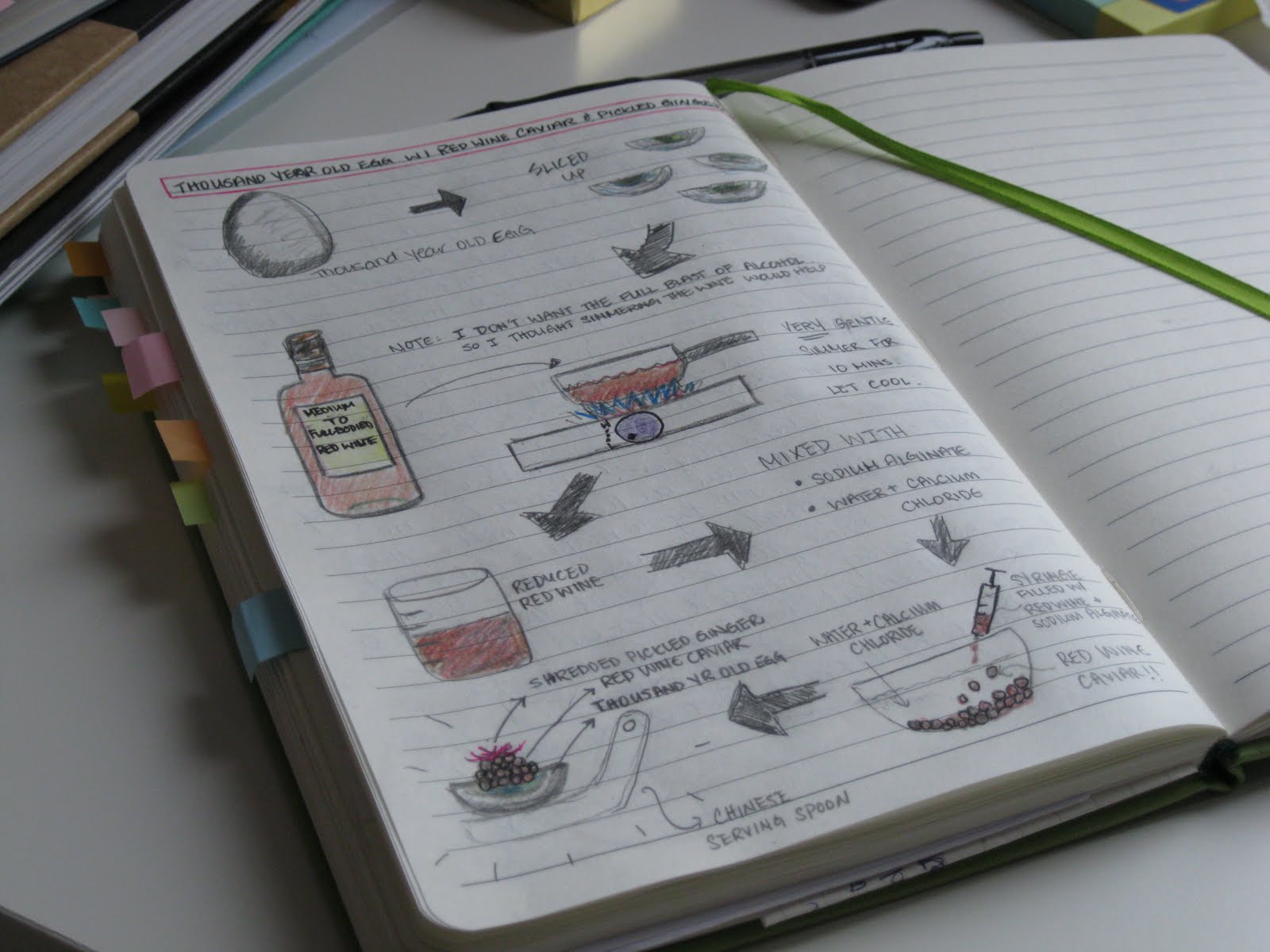
Thousand Year Old Egg with Red Wine Caviar and Pickled Ginger Crisp
I coloured it cause it looks nicer. This is my food diary btw.
Basically, you use the molecular cuisine techniques and turn the red wine into 'caviar' - which I do know how to make, but I just don't have the ingredients to do it. So when you bite into them, breaking the very thin layer of 'skin' encapsulating the liquid, you get a burst of red wine in your mouth, along with the pidan and pickled ginger. Present this on a tiny little Chinese soup spoon. Is like that Xiaolongbao @ Bo Innovation by Alvin. This little drawing of mine doesn't show how you can turn pickled ginger into pickled ginger crisp because I don't know how!! But I am pretty sure you can turn anything into crisp by extracting the flavor and just do some molecular thingy to it.
People, get me a molecular gastronomy cooking kit please!!!
p.s. I wonder if cheese would go well with Chinese Xiao Shing wine or Wu Liang Yi.
I've actually done a few at KEE where we hosted dim sum lunch and paired with various different wines, with wine makers explaining why it works and with the chefs commenting on how he got his inspirations on matching spring rolls with a glass of light pinot gris.
Anyways, before I get too far off topic, this post is about an awesome discovery for me, one of the few posts about chinese food & wine pairing. Apparently, the Chinese Thousand Year Old Egg (皮蛋 / Pidan) with pickled ginger pair rather well with red wines (and sweet whites too). This is of course not a new discovery/delicacy as Yung Kee (famous for their thousand year old eggs as well as roast goose) has been serving their guests this combo for awhile.
But is an 'omgosh' moment for me. Reaction was "@*$#&(#_)*^&%@&$)@!".
Red wine & pidan wor. Dim duk ga. cannot la! But if Yung Kee is serving this proudly, there's gotta be some truth behind this.
I finally had a chance to try it tonight and it was indeed a very pleasant surprise. Why I think the flavours work together is because of science. Through preserving, the thousand year old egg has a higher alkaline level (higher pH balance makes this a 'base'). And that's why when you eat it with the pickled ginger, which has a low pH balance and is a 'acid', the base and the acid neutralize each other, creating a very well-balanced taste. The wine in this case is the acid.
For this combo, you should drink midrange red wines, with medium to full bodied. Don't go break you bank and buy yourself a pricey red wine. I have a bottle of Spanish wine from the Rioja region - LAN, Gran Reserva, 2003. I first took a bite of the egg without the pickled ginger and then took a sip of wine. The wine took away the very pungent and sharp taste of the thousand year old egg. You know sometimes these Pidan can leave your throat kinda dryish? The wine took away that sensation. And what did the egg do to the wine? Well, it decreased the tannin of the wine and so I didn't have that funny coating in my mouth. I guess you can compare it to wine and cheese. The 2nd bite I added the pickled ginger which was so much better! An explosion of very complex flavours in your mouth, swirling around. The pickled ginger brought out more flavor from the Pidan, and then you have the flavor of the wine ... that was my confirmed 'omgosh' moment! The pickled ginger is equivalent to the quince jelly or the grapes that come with the cheese platter. Pidan is the Chinese cheese in this case.
Try it. Is quite tasty!
I apologize for not being able to give you a better description on this flavor combo. I just don't have the words to describe it!! JUST TRY IT.
But taking a bite of the pidan and then quickly take a sip of wine isn't a very classy thing to do. You get that mucky lip print around the rim of your glass and you can't slurp your wine with food in your mouth. The whole thing can get messy.
And so, this calls for brainstorming a dish that would incorporate red wine, pidan and pickled ginger.
Think, think, think.
You can't cook the pidan because you need the gooey, creamy yolk for this to work. I don't know if you make a thick red wine reduction sauce and drizzle it onto the pidan will have the same effect as drinking the wine since cooking takes away the alcohol in the wine and I don't know if this will change the pH level of the wine. You can't just reduce the wine half way and still have the 'sauce' very watery. You don't want your dish to look like as if the pidan is drowning in watery grape juice. Presentation counts. I also thought about soaking the pidan in red wine for days just like the traditional 'tea leaves eggs'. I could give this a go.
But if I can think of a dish that can preserve the original state of these 3 ingredients, that would be great, wouldn't it? And THANK YOU to watching way too many episodes of Heston's Feast, having eaten at Bo Innovation and having been around Chef B while working at KEE ... I've got it. I present to you ...
Thousand Year Old Egg with Red Wine Caviar and Pickled Ginger Crisp
I coloured it cause it looks nicer. This is my food diary btw.
Basically, you use the molecular cuisine techniques and turn the red wine into 'caviar' - which I do know how to make, but I just don't have the ingredients to do it. So when you bite into them, breaking the very thin layer of 'skin' encapsulating the liquid, you get a burst of red wine in your mouth, along with the pidan and pickled ginger. Present this on a tiny little Chinese soup spoon. Is like that Xiaolongbao @ Bo Innovation by Alvin. This little drawing of mine doesn't show how you can turn pickled ginger into pickled ginger crisp because I don't know how!! But I am pretty sure you can turn anything into crisp by extracting the flavor and just do some molecular thingy to it.
People, get me a molecular gastronomy cooking kit please!!!
p.s. I wonder if cheese would go well with Chinese Xiao Shing wine or Wu Liang Yi.
Sunday, February 6, 2011
Is like chemistry class all over again
Motivated by all the festivities of CNY around me, I have decided to make a rather popular Chinese dessert - Osmanthus Jelly (Gwai Fa Go). I love this stuff. Is so fragrant and light and is just what we need for CNY since we are always overeating, but you cannot not have any desserts.

(this is what Osmanthus looks like)

(the dried stuff)
Is a very simple dish to make but what was a bit of a challenge was to get the powdered gelatin and liquid ratio right. This Chinese 'jello' is firmer & chewier than your usual western jello (where it giggles more). Since I was never a dessert making person, I am ashamed to say that this was my first time experimenting with powdered gelatin.
I researched online and looked through many sites and gelatin packages to find out what should be the right ratio. I had my electric scale with me, my measuring cups and the whole lot. It felt a lot like high school chemistry class all over again. Being a person with not much common sense and forgetting that this jelly should be firmer in texture, I went with the "usual ratio" (and more liquid), and thus my Osmanthus Jelly turned out to be what you can say, a puddle of goo.
The 2nd trial, I cut half the liquid but used the same amount of gelatin powder and after 3 hrs of refrigeration, my Osmanthus Jelly finally set - with a deep golden color and specs of red from the goji berries, adorned with little petals from the dried Osmanthus. It was just gorgeous. Well, at least to me it was.
Here's the recipe for this lovely dessert:

550ml water
100ml room-temp water
2 packs of gelatin (24g)*
80-100g rock sugar
1T dried osmanthus (or you can use osmanthus sugar - adjust the taste with the rock sugar)
10g goji berries (weighted and soaked in hot water for around 5-10mins)
1. boil 550ml water in a pot with rock sugar. Stir until dissolved.
2. turn to low heat and add in the goji berries & the dried osmanthus. simmer for 3-5mins until fragrant. Turn off heat and set aside.
3. put 100ml room-temp water in a bowl and sprinkle the powdered gelatin on top. let sit for 30secs and slowly whisk together with a fork. Let stand for 3 mins.
4. Slowly ladle some of the osmanthus mixture into the gelatin mixture and stir together. (By tempering the gelatin mixture before pouring it in into the hot mixture prevents clumping).
5. Once the gelatin starts to dissolve, you can pour the gelatin mixture back into the osmantus mixture. Stir until will mixed together.
6. Pour into individual molds or whatever jelly molds you have and refrigerate for at least 3 hours.
7. Once set, cut into pieces and enjoy with a cup of good Chinese tea!
*here are some tips on using gelatin
a. 1T of powdered gelatin sets 2 cups of liquid (475ml), firm enough to unmold
b. 1T of powdered gelatin = 4 leaves of gelatin
c. UK brands packaged gelatin usually comes in 11g/pk. This will sent 1 pint liquid (600ml) - though I would suggest you always weight your pkg'd gelatin to make sure.
d. Always add gelatin to water, not the other way around. Sprinkle powdered gelatin into cold water. Mix and let stand for 3-5mins
e. Temper the gelatin mixture with hot liquid before adding the mixture into the hot liquid all at once.
f. NEVER boil gelatin

(this is what Osmanthus looks like)

(the dried stuff)
Is a very simple dish to make but what was a bit of a challenge was to get the powdered gelatin and liquid ratio right. This Chinese 'jello' is firmer & chewier than your usual western jello (where it giggles more). Since I was never a dessert making person, I am ashamed to say that this was my first time experimenting with powdered gelatin.
I researched online and looked through many sites and gelatin packages to find out what should be the right ratio. I had my electric scale with me, my measuring cups and the whole lot. It felt a lot like high school chemistry class all over again. Being a person with not much common sense and forgetting that this jelly should be firmer in texture, I went with the "usual ratio" (and more liquid), and thus my Osmanthus Jelly turned out to be what you can say, a puddle of goo.
The 2nd trial, I cut half the liquid but used the same amount of gelatin powder and after 3 hrs of refrigeration, my Osmanthus Jelly finally set - with a deep golden color and specs of red from the goji berries, adorned with little petals from the dried Osmanthus. It was just gorgeous. Well, at least to me it was.
Here's the recipe for this lovely dessert:

550ml water
100ml room-temp water
2 packs of gelatin (24g)*
80-100g rock sugar
1T dried osmanthus (or you can use osmanthus sugar - adjust the taste with the rock sugar)
10g goji berries (weighted and soaked in hot water for around 5-10mins)
1. boil 550ml water in a pot with rock sugar. Stir until dissolved.
2. turn to low heat and add in the goji berries & the dried osmanthus. simmer for 3-5mins until fragrant. Turn off heat and set aside.
3. put 100ml room-temp water in a bowl and sprinkle the powdered gelatin on top. let sit for 30secs and slowly whisk together with a fork. Let stand for 3 mins.
4. Slowly ladle some of the osmanthus mixture into the gelatin mixture and stir together. (By tempering the gelatin mixture before pouring it in into the hot mixture prevents clumping).
5. Once the gelatin starts to dissolve, you can pour the gelatin mixture back into the osmantus mixture. Stir until will mixed together.
6. Pour into individual molds or whatever jelly molds you have and refrigerate for at least 3 hours.
7. Once set, cut into pieces and enjoy with a cup of good Chinese tea!
*here are some tips on using gelatin
a. 1T of powdered gelatin sets 2 cups of liquid (475ml), firm enough to unmold
b. 1T of powdered gelatin = 4 leaves of gelatin
c. UK brands packaged gelatin usually comes in 11g/pk. This will sent 1 pint liquid (600ml) - though I would suggest you always weight your pkg'd gelatin to make sure.
d. Always add gelatin to water, not the other way around. Sprinkle powdered gelatin into cold water. Mix and let stand for 3-5mins
e. Temper the gelatin mixture with hot liquid before adding the mixture into the hot liquid all at once.
f. NEVER boil gelatin
Tuesday, February 1, 2011
Grandma's Cooking
My grandma is a fabulous cook. Whose grandma isn't a fabulous cook? I have never heard anyone complained about his/her grandma's cooking. Is just so familiar. You grew up with it. The tastes are sometimes exactly what you need after a long day at work.
One of the dishes that I really wanted to learn from my grandma is her famous white raddish (turnip) cake that she always make for Chinese New Year. They are delicious steamed or pan fried. I always ask her for the recipe but her answer was always "I don't have one ... you just mix everything together and steam it. Is all about the feel of things," she said.
The consistency of the batter - grams just know if she needs more water or rice flour just by stirring the mixture with a pair of long wooden chopsticks.
A generous amount of salt, white pepper and chicken powder - but not too much because the Chinese sausages (laap cheung)can be quite salty. Then you balance the flavor out with a touch of sugar.
No quantities and measurements for the ingredients yet every time grandma can give you that same perfect taste & texture. I do not know how she does it.
Anyways, in hopes to continue the tradition (it skipped a generation since my mom hates to cook), I have made my very first turnip cake for this Chinese New Year. And let me tell you, it is all about trial and error. I know what is supposed to go into the batter, but I didn't bother writing down the exact amount as that would defeat the purpose of learning from grandma. I want to be like her and just know what to do with this family's favorite.


My dad did the taste test this time - first bite was grandma's, second bite was mine. Not too far away from mastering this dish, he said.
One of the dishes that I really wanted to learn from my grandma is her famous white raddish (turnip) cake that she always make for Chinese New Year. They are delicious steamed or pan fried. I always ask her for the recipe but her answer was always "I don't have one ... you just mix everything together and steam it. Is all about the feel of things," she said.
The consistency of the batter - grams just know if she needs more water or rice flour just by stirring the mixture with a pair of long wooden chopsticks.
A generous amount of salt, white pepper and chicken powder - but not too much because the Chinese sausages (laap cheung)can be quite salty. Then you balance the flavor out with a touch of sugar.
No quantities and measurements for the ingredients yet every time grandma can give you that same perfect taste & texture. I do not know how she does it.
Anyways, in hopes to continue the tradition (it skipped a generation since my mom hates to cook), I have made my very first turnip cake for this Chinese New Year. And let me tell you, it is all about trial and error. I know what is supposed to go into the batter, but I didn't bother writing down the exact amount as that would defeat the purpose of learning from grandma. I want to be like her and just know what to do with this family's favorite.


My dad did the taste test this time - first bite was grandma's, second bite was mine. Not too far away from mastering this dish, he said.
Subscribe to:
Posts (Atom)